

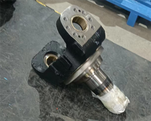
In agricultural machinery (such as tractors), the steering knuckle is a key component of the steering system. Its functions are similar to those of automobile steering knuckles but must adapt to the complex and variable working environment of farmland.
As a hinge for wheel steering: The steering knuckle connects to the front axle via the kingpin, allowing the front wheels to pivot around the kingpin for vehicle steering.
Transmitting steering force and motion: It transfers torque from the steering mechanism (such as rack and pinion or recirculating ball type) through the steering rods and knuckle arms to the wheels, driving them to turn.
Supporting wheels and bearing loads: The steering knuckle connects the wheels to the suspension system, not only supporting wheel rotation but also bearing impact loads from the ground and multidirectional forces during operation.
Enhancing handling stability: In agricultural machinery, the steering knuckle is often designed with a rearward-tilted kingpin to improve front wheel ground contact, increase traction and grip, and make steering more flexible and responsive, suitable for slippery and uneven field conditions.
Ensuring steering accuracy and safety: Its high-precision manufacturing ensures that the wheel turning angle corresponds correctly to the steering wheel angle, achieving precise control and reducing the risk of slipping or loss of control.
Functions of Steering Knuckles in Agricultural Machinery
Jan 13, 2026



Send Inquiry