
If you’ve ever crouched under a car during a routine oil change or watched a mechanic align the front end, you’ve probably glanced at two nondescript metal parts tucked near the wheel well: the steering knuckle and the tie-rod end. Most drivers don’t think much about them, but these two components form the critical link between a driver’s steering input and the front wheels that turn the car. As a steering knuckle supplier, I’ve spent thousands of hours working with these parts—from designing prototypes for electric vehicles to troubleshooting fit issues for heavy-duty pickup trucks—and I can tell you their interaction is far more precise than it looks. It’s not just a bolt holding two pieces together; it’s a finely tuned system that balances force, wear, and control, all while withstanding the constant jostle of road debris, potholes, and high-speed turns. Let’s break down how these two parts work together, why the details matter, and what I’ve learned over the years about making them work reliably for vehicles on every type of road.
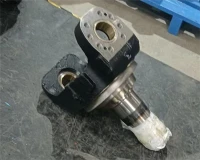
First, let’s set the stage with what each part does on its own, because you can’t understand their interaction without knowing their individual roles. The steering knuckle is the central hub that connects the front wheel’s bearing assembly to the rest of the suspension. It’s cast from strong, durable metal—usually cast steel or ductile iron, depending on whether it’s for a compact sedan or a 3/4-ton truck. This part has several mounting points: one for the wheel hub, two brackets for the upper and lower thrust rods (those are the links that hold the suspension in place vertically), and one socket that connects to the tie-rod. You can see a close-up of a properly engineered steering knuckle here, which shows all these key features clearly.
The tie-rod end, on the other hand, is a smaller, more specialized component. Think of it as the “translation” piece between the steering gear (the rack or box under the dashboard that turns your steering wheel) and the steering knuckle. It’s made of a steel housing that encloses a ball joint, with a threaded rod on one end that screws into the steering gear’s tie-rod assembly, and a tapered pin on the other end that bolts to the steering knuckle. The ball joint inside allows the tie-rod end to pivot as the suspension moves up and down over bumps, while the threaded connection adjusts the toe angle—how parallel the front wheels are to each other, which is critical for tire wear and steering stability.
Now, the actual interaction starts with the fit between the tie-rod end’s tapered pin and the steering knuckle’s mounting hole. This isn’t a random fit; it’s a precision taper, usually 1:50 or 1:16, designed to create a metal-to-metal lock when the nut is tightened. When you torque the nut to spec, the tapered pin is pulled firmly into the knuckle’s taper hole, which eliminates any play between the two parts. Play here is a bad thing—even a tiny amount (a fraction of a millimeter) can cause steering wander, uneven tire wear, or even clunking sounds when you drive over bumps. As a supplier, we test every batch of steering knuckles for taper hole concentricity, because even a 0.02mm deviation can throw off the lock and create play over time.
But it’s not just the taper fit that matters. The tie-rod end’s ball joint has to articulate smoothly while transferring steering force, and the steering knuckle has to provide a rigid mounting point that doesn’t flex under load. Here’s where the rest of the suspension system comes into play. The steering knuckle is also connected to the upper and lower thrust rod brackets, which attach to the swing arm—another key suspension component that supports the wheel’s weight. When you turn the steering wheel, the rack pushes or pulls the tie-rod, which in turn pulls or pushes the steering knuckle, making the entire wheel and suspension assembly pivot around the swing arm’s pivot point. If any of these parts are misaligned, the steering knuckle’s movement isn’t smooth, and the tie-rod end has to work harder to keep the wheels turning correctly.
I remember a project a few years back with a small electric vehicle manufacturer that was having premature tie-rod end failures on their test fleet. Their initial design used a standard off-the-shelf steering knuckle from a generic supplier, and when we tore down a failed unit, we noticed two issues. First, the knuckle’s tie-rod mounting hole had a rough inner surface that caused the tapered pin to seat unevenly, creating micro-movements that wore out the ball joint in the tie-rod end faster than it should. Second, the knuckle’s thrust rod brackets were slightly underdesigned, so when the EV’s heavy battery caused extra load on the front suspension, the knuckle flexed just enough to put side pressure on the tie-rod end, which damaged the ball joint seals and let water and road grit in. We worked with their engineering team to adjust the knuckle’s casting tolerances for the taper hole and reinforce the thrust rod brackets, using a high-grade cast steel frame casting for the suspension’s main structure to improve overall rigidity. After that, their tie-rod end failure rate dropped by 90%, and the test drivers reported much more responsive steering.
Another key part of their interaction is load distribution. When you take a sharp turn at 50 mph, the front wheels bear a lot of lateral force—this force goes through the tire, wheel hub, steering knuckle, and then the tie-rod end, which transfers it to the steering gear. The steering knuckle has to handle that lateral load without twisting or bending, because any twist here would mean the tie-rod end isn’t applying even force to the wheel, leading to uneven turning. The tie-rod end’s ball joint is designed to handle both lateral force (from turning) and radial force (from bumps), so it has to be able to pivot smoothly in multiple directions while maintaining that rigid connection to the knuckle. If the knuckle’s taper hole is worn or distorted from years of use, the ball joint can’t pivot correctly, leading to binding in the steering, which is a safety hazard.
Regular maintenance is all about checking this connection. A mechanic will lift the front of the car, grab the top and bottom of the wheel, and wiggle it back and forth to check for play in the steering knuckle-tie rod end joint. If there’s any noticeable movement, that means the taper has worn, or the tie-rod end’s ball joint is failing. For someone like me, that’s a reminder of why precision manufacturing is non-negotiable. Even the best design is only as good as the parts that go into it, and as a steering knuckle supplier, we have to balance strength, weight, and cost without sacrificing that critical fit between the knuckle and the tie-rod end.
One thing that’s often overlooked is the corrosion factor. Steering knuckles are mounted low on the car, so they’re exposed to road salt, water, and dirt in cold climates, and road grime everywhere else. If the taper between the knuckle and tie-rod end gets corroded, it can be almost impossible to separate the two parts when it’s time for a replacement. That’s why many modern tie-rod ends have a grease fitting that lets you lubricate the ball joint, which also helps keep corrosion out of the taper area. We started adding a small grease channel in the knuckle’s taper hole a few years ago, and it’s made a huge difference in service life for customers in areas with harsh winters—it prevents corrosion from seeping into the joint and makes future maintenance much easier.


Looking ahead to electric vehicles and autonomous driving, this interaction is going to become even more important. Autonomous systems need extremely precise steering control, so any play in the steering knuckle-tie rod end joint can lead to errors in lane keeping or steering correction. That means tighter tolerances, stronger materials, and more rigorous testing for these parts. For example, some EV manufacturers are using aluminum steering knuckles to save weight, but aluminum has different wear characteristics than cast steel, so we’ve had to adjust our manufacturing processes to ensure the taper hole has the right hardness to mate with steel tie-rod end pins without wearing too quickly. It’s a new challenge, but it’s also a chance to refine what we already know about how these two parts work together.
At the end of the day, the steering knuckle and tie-rod end are a perfect example of how even the most basic-looking parts are critical to a car’s performance and safety. They don’t get the fanfare of infotainment systems or powerful engines, but without them, you can’t steer the car at all. As a steering knuckle supplier, I take pride in making parts that work seamlessly with every other component in the front suspension, whether that’s the upper thrust rod bracket, swing arm, or tie-rod end. If you’re a mechanic, a fleet manager, or an engineer working on a new vehicle project, and you’re looking for high-quality, precision-cast steering knuckles designed to work reliably with all your suspension components, we’d be happy to discuss your needs.
References:
- J670 - Terminology for Automotive Steering Systems, SAE International, 2022.
- Cast Steel Suspension Components for Light Vehicles, Association for Iron and Steel Technology, 2021.
- Steering System Wear and Failure Analysis, Automotive Engineering International, Vol. 129, No. 5, 2020.
- Taper Joint Design for Automotive Suspension Connections, Proceedings of the International Conference on Automotive Engineering, 2019.
- Corrosion Mitigation for Underbody Automotive Components, Journal of Corrosion Science and Engineering, Vol. 22, No. 3, 2021.